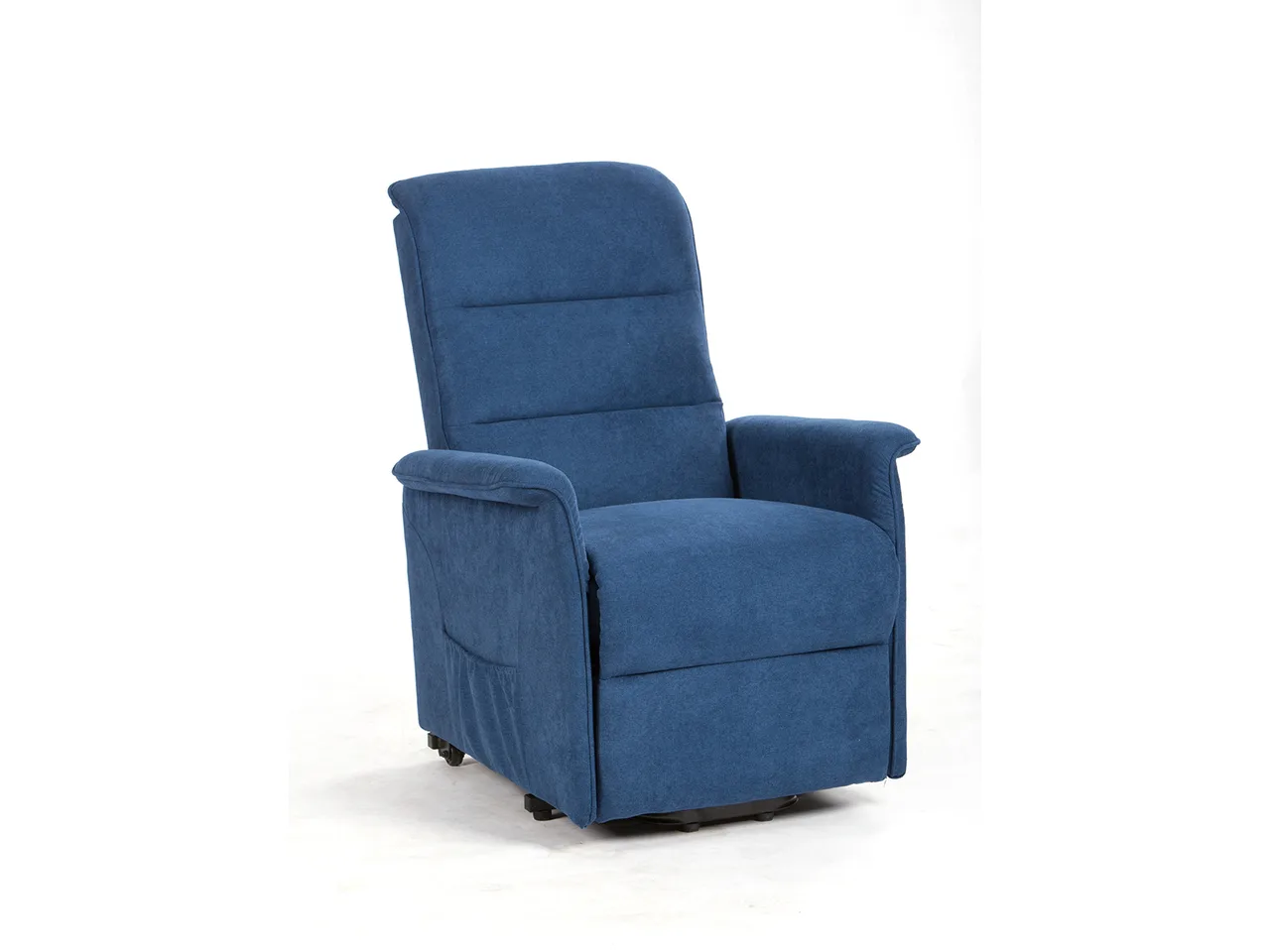
When we design an elderly-care chair, the resident is only half the brief. The other half is the person who cleans that chair — often several times a day, with chemicals that would destroy a domestic armchair in a season. Most seating that fails in care homes does not fail structurally. It fails hygienically: covers that crack, seams that drink fluid, crevices that cannot be reached with a wipe. So here is how the infection-control side of a care seating spec actually gets built.
The cover: wipeable is a property, not a look
The baseline for clinical and care seating is a fluid-resistant surface — healthcare vinyl or a coated polyurethane fabric — because a woven fabric soaks up whatever reaches it and holds it in the weave. Between vinyl and coated PU the honest trade-off is feel against ruggedness: vinyl is the harder-wearing, more chemical-tolerant surface and reads more institutional; coated PU feels warmer and more residential — which matters in a sector trying not to look like a hospital — but the coating is the part doing all the work, and a cheap PU coating cracks at the flex points within a couple of years. Once a wipeable surface cracks, it is worse than fabric: fluid enters through the crack and cannot be cleaned out from under an impermeable skin.
The specification line that separates serious suppliers is hydrolysis resistance on PU covers — resistance to the slow breakdown caused by warmth, moisture and cleaning chemistry, which is precisely a care home's daily climate. Ask for the rating in weeks of tropical-test exposure, and ask for it in writing.
Disinfectant compatibility: the spec everyone skips
Care homes do not clean with soap. Depending on the outbreak protocol, the same chair may see quaternary compounds, alcohol wipes and chlorine solutions — and chlorine at outbreak concentrations is brutal on coatings that are not rated for it. The failure mode is slow: the surface stiffens, micro-cracks, then sheds. So the procurement question is not "is it wipeable?" but "wipeable with what, at what concentration, how many cycles?" We match the cover to the home's actual cleaning agent list at the sample stage, because a cover warranty that excludes the disinfectant the home actually uses is not a warranty.
Seams, gaps and the geometry of cleanable
A wipeable cover on an uncleanable shape achieves nothing. Sewn seams are needle-punctured by definition; on the seat surfaces that catch spills we use welded or sealed seam constructions instead, and we keep decorative piping — a dirt channel by design — off care models entirely. The crevice between seat and armrest is where everything ends up, so the geometry has to either close that gap or open it wide enough for a gloved hand and a wipe; halfway is the worst of both. Under the cushion, a removable seat deck or a drop-through gap means a spill that gets past the cover can be reached, cleaned and dried instead of soaking into the frame. And a moisture barrier between cover and foam protects the one component that can never be disinfected — once foam is contaminated, the only treatment is replacement, so we design cushions to be replaceable as a part, not an upholstery job.
Fire spec and the rest of the chair
None of this suspends the fire requirements — care-home upholstery in most export markets still has to pass the ignition tests we walked through in our fire-codes note, and the cover/barrier/foam combination has to pass as a build, not as three separately certified materials. Our care seating is built and tested to the relevant EN methods and testing can be arranged per order on the actual upholstery build you select. The mobility side of the design — seat height, firmness and lift-assist — is its own subject, covered in our care-chair design note; the infection-control spec sits on top of it, not instead of it.
One word on antimicrobial marketing: a silver-ion label is not a cleaning protocol, and we will not sell it as one. Surfaces that tolerate real disinfectants, seams that keep fluid out and gaps a wipe can reach do the work; the additive is at best a supplement.
Do not forget the parts that are not upholstery
The wipe-down regime hits the whole chair, not just the cover. Armrest tops take more cleaning contact than any other surface — hands rest there, spills land there, and every disinfection pass crosses them — so they want a sealed, non-porous finish; an open-pored or waxed timber arm becomes unhygienic the day its finish wears through, while a fully sealed timber or polyurethane arm cap survives the chemistry. Exposed metal gets the same scrutiny: chlorine mist corrodes bare fasteners, so coated frames and capped fixings are not cosmetic choices. And the practical test beats the datasheet — when a home trials our sample, we ask the housekeeping team, not just procurement, to live with it for two weeks and run their full cleaning protocol on it. A chair that fails the cleaner fails the home, whatever the brochure said.
What to put in the tender line
If you are writing the spec, five lines cover the ground: cover type with hydrolysis rating; the disinfectant list the cover must tolerate, by agent and concentration; welded or sealed seams on horizontal surfaces, no piping; removable/replaceable cushion units with moisture barrier; and ignition-test compliance on the complete build. Send us that list and the resident profile through the contact page and we will sample against it — or start from our product range and tighten from there.