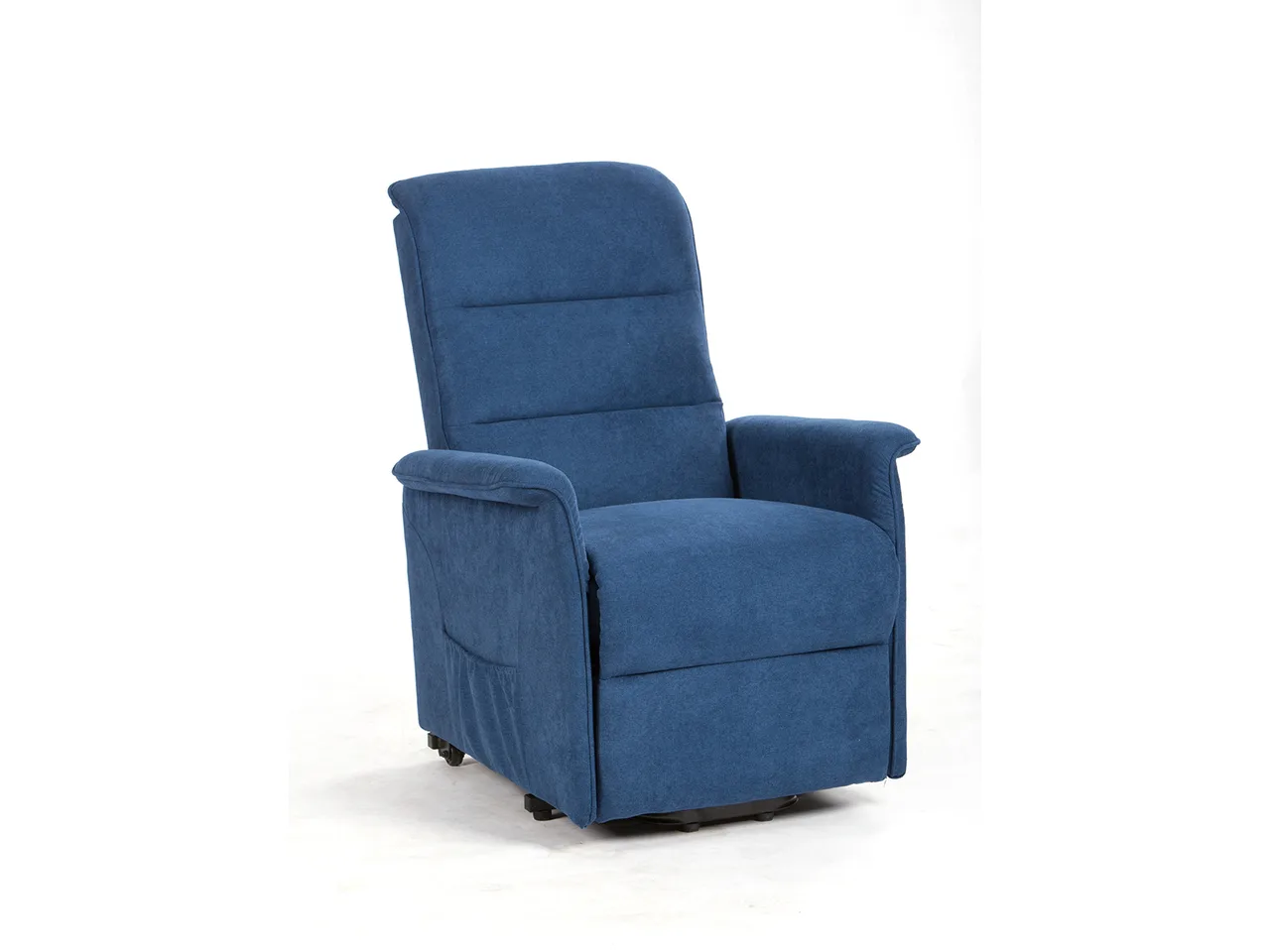
The segment we have leaned into most in recent years is elderly-care seating, and it taught us a hard lesson early: a care chair is judged on standing up, not sitting down. A domestic recliner is tuned to let you sink in. An aged-care chair has to let a frail user — or a carer helping one — get back out. That inverts most of the brief.
Seat height and depth come first
Occupational therapists who fit these chairs treat seat depth as the single most important measurement. The target is a roughly 90° angle at the knee and hip with the feet flat on the floor: too deep and the user slides forward or cannot use the backrest; too shallow and the thighs are unsupported and pressure concentrates. Seat-to-floor height matters just as much. A higher seat is easier to rise from and lets a carer work without stooping; too high and the feet dangle. Because users differ, a care-home roll-out often mixes a few seat heights rather than one — we would rather supply a range than pretend one height suits a whole floor.
Firmness, the front edge, and pressure
Softer is not kinder here. A seat that is too soft swallows a light, frail user and makes rising a struggle, so we run a firmer high-resilience foam and a slightly raised front edge to help the legs do their work. There is a clinical reason to get this right beyond comfort: studies of specialised aged-care seating report large reductions in pressure injuries — figures around a 75% drop have been cited after switching from unsuitable chairs. Correct dimensions plus head and lateral support keep a user in midline posture and spread load instead of concentrating it on one point.
Lift-assist and tilt-in-space
Two mechanisms do the heavy lifting. A powered lift base tilts the whole seat forward to bring someone gently up toward standing — single-motor for a basic rise, dual-motor when the back and footrest need to move independently. Tilt-in-space rotates the seat and back as one unit, shifting body weight across a larger area to manage pressure for someone who cannot reposition themselves. They solve different problems: lift-assist is about transfers, tilt-in-space is about staying seated safely for hours. We ask which one the resident actually needs before quoting, because the mechanism is most of the cost.
The trade-off: home buyer vs facility
The cleaning and durability spec is where home and facility orders genuinely diverge, and it is worth being blunt about it. For a single home, a comfortable fabric and a single-motor lift is often enough. For a facility, infection control will ask for wipe-clean PU or waterproof-backed fabric that survives repeated disinfectant wipes without cracking, plus a frame rated for far heavier daily use. Quoting a home-grade chair into a care home looks cheaper and costs more in year two. Tell us which it is and the spec changes honestly.
The details that decide a care order, not the brochure shot
Beyond the seat and the mechanism, a handful of small specs decide whether a care chair works in practice. Casters versus glides: a chair that has to be wheeled to a window for the afternoon needs lockable casters, but a chair used for transfers wants fixed glides so it cannot roll away as someone stands. Armrest height and shape matter more here than anywhere — a frail user pushes up through the arms, so they need to be at the right height and run far enough forward to bear weight near the front of the seat, not stop halfway back. And weight capacity is not a marketing number on these chairs; a bariatric resident needs a frame and lift motor rated for it, and quoting a standard chair into that role is a safety problem, not a saving. We ask about all three before we quote, because a care home cannot quietly swap a chair that turns out wrong for a resident.
If you are fitting out a care home or sourcing for aging-at-home buyers, send the use case — single home or facility, plus which mechanism you need (lift-assist or tilt-in-space) — and we will quote the real thing. We build to seating-durability patterns and lift-mechanism testing can be arranged. See the elderly-care line or start at the contact page; mixed orders with our office and auditorium lines are normal here.