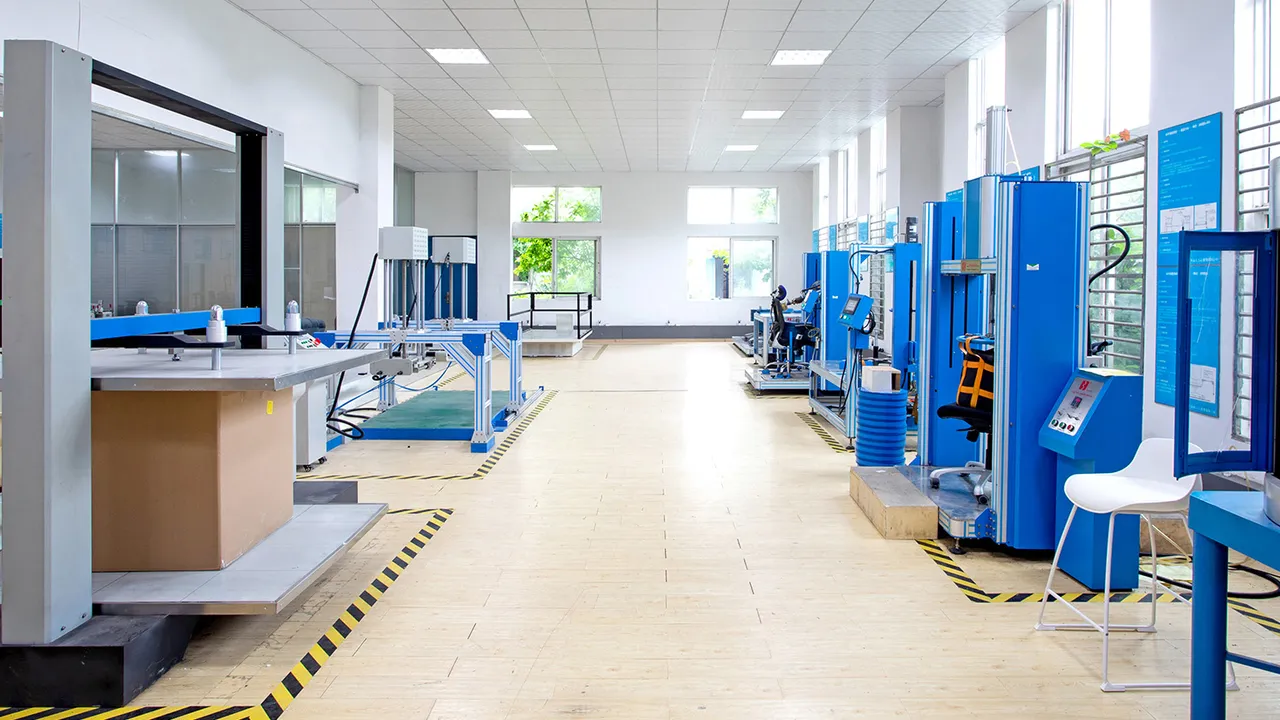
Buyers who source office chairs arrive fluent in BIFMA and EN 1335 and then ask us to apply those to a theatre seat. They do not fit. Fixed, floor- or wall-mounted seating is covered by its own standard, EN 12727, and it grades a seat by how hard the room will treat it — not by office-task cycles.
What EN 12727 actually covers
EN 12727 applies to ranked seating — rows permanently fastened to the floor or wall, whether individual seats or benches: cinemas, lecture theatres, stadiums, multipurpose halls. It sets test methods and pass requirements for strength and durability, and it sorts seating into four levels, L1 through L4, by severity of use. L1 is light, general use; L4 is severe use. A school hall, where teenagers drop into seats hard and often, is commonly specified at L4. A low-traffic boardroom-style lecture room may sit at L1 or L2.
The tests behind the level
The level is earned across three families of test. Repetitive (fatigue) tests cycle the parts that move or carry load — the tip-up mechanism, the seat-to-standard attachment, the backrest — to prove they survive years of daily use. Static tests load the seat and back to check stability and permanent deformation. Impact tests are the brutal-but-realistic ones: kicks, knocks and people sitting down heavily or, in a stadium, standing on the seat. The higher the level, the more cycles and the higher the loads.
The trade-off: over-spec costs too
Here is the call we help project buyers make. Under-specifying is the obvious risk — an L1 seat in an L4 room comes back as broken tip-ups and cracked attachments inside a couple of seasons, and on fixed seating a warranty wave means a contractor back on site, not a parcel. But over-specifying is a real cost too. Building every seat in a quiet corporate auditorium to L4 means heavier steel standards and more material per seat for use the room will never see. We would rather match the level to the actual traffic: L4 where it gets abused, a lower level where it does not, and a written reason for each.
One honest limit on language: we build to EN 12727 patterns and the level you specify, and third-party testing to that level can be arranged per order. We do not stamp a blanket "L4 certified" on a catalogue — the level belongs to a tested build, which is why we lock it at the sample stage on a fixed-seating order.
Where the level shows up in the build
A higher EN 12727 level is not a sticker; it changes the parts. The tip-up return mechanism gets a heavier spring or a better-bushed pivot so it survives more cycles. The seat-to-standard bracket is thicker, and the steel leg standard itself goes up a wall thickness — a 2 mm tube where a 1.5 mm would pass at L1 or L2. The fixings into the floor or riser are specified to the same level, because an L4 seat on an under-spec floor anchor just moves the failure point. When we quote a level, we list which of these changes it drives, so you can see the cost is in metal and mechanism, not margin.
The other thing the level decides is your spare-parts plan over a fifteen- to twenty-year life. A correctly levelled seat fails predictably and slowly; an under-levelled one fails in clusters, usually at the tip-up, two or three seasons in. We would rather you carry a small buffer of springs and brackets matched to the level than discover a discontinued part stranding a row — which is why we tie the level to a parts list at order, not after.
Tell us the venue type and expected traffic and we will recommend an EN 12727 level with the reasoning, not just the highest number. Pair it with the right fire spec from our fire-code note, and the layout from our row-spacing guide. Questions go to the contact page.